BIM & Digital Twins Lab
GUTEC University Digital Engineering, BIM Modeling, and Digital Twins Laboratory

The BIM & Digital Twins Lab is the flagship laboratory of Research & Labs at GUTEC University, created to accelerate the real-world adoption of digital engineering, BIM methodology, and digital twins in building, infrastructure, and critical asset projects. Its approach combines applied research, technology transfer, and advanced training, connecting the academic world with industry and the real challenges of the AEC (Architecture, Engineering & Construction) sector.
This laboratory does not work “only” with models. It works with complete information systems: from the definition of standards and collaborative environments to integration with real-time data, IoT/OT, maintenance, operation, and performance. The goal is clear: to convert projects into operable digital assets, where decision-making is based on evidence, traceability, and control.
What is the BIM & Digital Twins Lab and why does it exist?
The construction sector has evolved more rapidly in terms of materials and construction techniques than in information management. For decades, the problem has not been a lack of technical knowledge, but rather fragmentation: scattered documents, uncontrolled versions, poor interoperability, lack of traceability, and a disconnect between design, construction, and operation.
The BIM & Digital Twins Lab was created to fill this gap from an international perspective. Its function is to promote an ecosystem in which:
BIM models are structured according to quality criteria and standards.
multidisciplinary coordination is real, measurable, and auditable
data becomes a strategic asset.
Operation and maintenance are supported by connected digital twins.
Reality capture (scan-to-BIM) and sensors transform information into a living system.
productivity, cost control, and sustainability are managed systematically.
This laboratory acts as a center for practical innovation: methodologies are designed, workflows are validated, prototypes are developed, and applied cases are generated that are useful for companies, administrations, and operators.
Líneas de investigación y desarrollo (I+D aplicada).
The BIM & Digital Twins Lab organizes its projects into lines of work that respond to today’s market needs.
A large part of BIM's success lies not in modeling, but in governance: how information is structured, who approves what, how versions are controlled, how incidents are managed, and how quality models are delivered.The following are developed and validated here:
- Internal modeling and nomenclature standards.
- BEP templates and responsibility matrices.
- Model quality control rules.
- Coordination and reporting procedures.
- collaborative environments that enable real traceability.
Rehabilitation and operation require reliable geometric accuracy. That is why the laboratory works intensively on reality capture: point clouds, photogrammetry, LiDAR, tolerance verification, and “as-designed vs. as-built” processes.Methodologies are developed to:
- convert point clouds into useful (not just “pretty”) as-built models.
- standardize levels of detail according to use (maintenance, renovation, audit).
- detecting deviations in construction.
- producing evidence-based technical documentation.
- speeding up inspections with digital tools.
The connection between BIM (assets) and GIS (territory) is key to mobility, drainage, resilience, and urban planning. The laboratory works on how to integrate geospatial data and asset models to create comprehensive representations: from neighborhoods to service networks.Use cases are being developed such as:
- urban digital twins for utilities.
- territorial impact and risk analysis on infrastructure.
- maintenance planning by area.
The laboratory develops digital twins with a real-world focus: energy, comfort, maintenance, safety, and operational continuity. A useful digital twin must answer specific questions:Which assets are critical and how do they behave?
Which consumption levels are normal and which are anomalies?
Which maintenance should I prioritize to avoid failures?
How do changes in operation impact cost and performance?
How do I detect degradation before it becomes an incident?Here, we investigate integration architectures with sensors and platforms, data models for assets, and dashboards for operation.
BIM scalability is achieved through automated quality control and clear rules. The laboratory develops protocols and workflows for:
- parameter validation.
- document consistency checking.
- interference auditing.
- automatic nomenclature and structure review.
- control of deliverables and milestones.
The laboratory applies analytics and artificial intelligence in useful scenarios: defect detection in inspections, incident classification, failure prediction, energy time series analysis, and decision-oriented dashboards.AI at GUTEC is approached from a practical standpoint: priority is given to cases where the return is measurable and implementation is feasible.
Laboratory Mission
The mission of the BIM & Digital Twins Lab is to lead applied innovation in BIM, digital twins, and intelligent asset lifecycle management, training talent and developing solutions that can be transferred on a global scale. The laboratory exists so that digitization ceases to be a concept and becomes an operational capability within real projects.
What makes this laboratory at GUTEC unique?
The unique value of the BIM & Digital Twins Lab lies in the fact that it covers the entire cycle:
A BIM that ends in design is an incomplete BIM. A digital twin without an operational purpose is just a visualization. At GUTEC, the lab connects:
Production, coordination, standards, interoperability, and deliverables.
4D planning, 5D measurements, change control, QA/QC, construction monitoring, and evidence.
Asset structure, maintenance, as-built documentation, manuals, warranties, and O&M plans.
Integration with IoT, BMS/SCADA, real-time data, alarms, dashboards, and analytics for optimization.
In addition, the laboratory incorporates an international vision: comparative methodologies, global standards, and the ability to adapt to multiple countries and regulatory frameworks, consistent with GUTEC’s global identity.
Laboratory infrastructure and ecosystem.
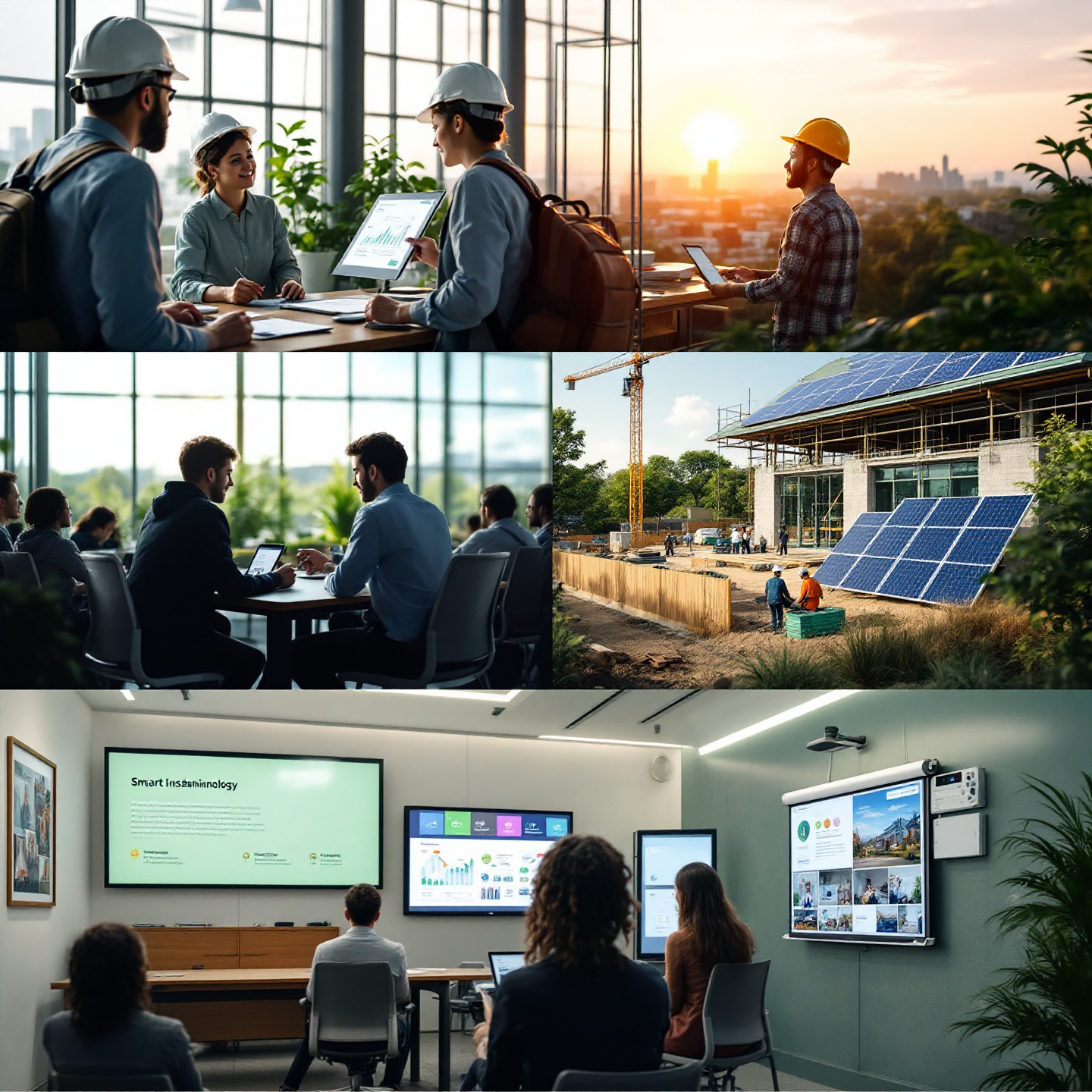
The BIM & Digital Twins Lab has a technical ecosystem geared toward real projects:
The laboratory has academic repositories of BIM and infrastructure models, parameter and family libraries, deliverable templates, and control procedures. It also integrates practice environments for CDE, coordination, and incident management, allowing students to work as if they were in a consulting firm or construction company.
For digital twins, the laboratory operates test environments with simulated and real data (depending on the project), designed to experiment with sensor integration, dashboards, and performance indicators.
The laboratory infrastructure focuses on two things: quality and replicability. What is developed here must be transferable to a company or operator.
Projects and case studies.
The BIM & Digital Twins Lab does not work in the abstract. Its projects are structured as cases with professional deliverables. Some examples of the types of projects developed by the laboratory:
- BIM digitization for the renovation of existing buildings using Scan-to-BIM methodology and As-Built delivery.
- BIM coordination of complex MEP installations with interference detection and change control.
- Operational digital twin for facility management: critical assets, maintenance, alarms, and dashboards.
- Digital asset inventory for operators: data structure, criticality, history, and documentation.
- Construction site control with reality capture: validation of progress, tolerances, and technical evidence.
- BIM-GIS integration for distributed assets: urban networks, campuses, multi-site facilities.
Each project is documented, evaluated, and turned into a case study for learning, publications, and transfer.
Laboratory services for companies and institutions.
As a global university, GUTEC uses its labs to collaborate with industry. The BIM & Digital Twins Lab offers a professional framework for collaboration with companies, administrations, and operators.
Typical services include:
- BIM maturity diagnosis and implementation plan
- Design of standards, corporate BEP, and CDE processes
- Audit of models, deliverables, and quality control
- Digital twin prototypes for critical assets
- Scan-to-BIM pilots for renovation or inventory
- In-company training applied to real-life cases from the company
- Technical support for tenders and digital delivery requirements
These collaborations are designed to be applicable, measurable, and scalable.
Opportunities for students and researchers.
The lab is also a platform for students to build a distinctive professional profile. Participating in the BIM & Digital Twins Lab means working with:
- real cases or professional simulations
- auditable deliverables (BEP, models, dashboards, QA/QC)
- international methodologies applied
- industry-oriented projects
- Urban and infrastructure models for GIS,
Students can join as applied research assistants, project collaborators, or participants in technical challenges. This experience is especially valuable for profiles seeking international employability in BIM, digital engineering, or digital twins.
Publications, working papers, and knowledge transfer.
The BIM & Digital Twins Lab produces useful knowledge: best practice guides, working papers, case studies, and technical documentation. The aim is not to publish for the sake of publishing, but to generate materials that become a reference for professionals and companies.
Typical topics include:
BIM governance, quality control, information standards, data models for assets, IoT-BIM integration, scan-to-BIM methodologies, BIM-GIS interoperability, and operational digital twin strategies.
How to collaborate with the laboratory.
Collaboration with the BIM & Digital Twins Lab can take many forms: from a technical pilot to an applied research project or a corporate training agreement.
To initiate a collaboration, GUTEC usually structures the process as follows:
First, the challenge or need is defined (e.g., BIM coordination, as-built, digital twin, construction control, or asset management). Next, the lab proposes a scope of work with clear deliverables, deadlines, roles, and success criteria. Finally, the project is executed and the learning is documented so that the organization can scale it up.
Extended FAQs
No. The lab is open to profiles in engineering, construction, operations, MEP, asset management, and technology. BIM and Digital Twins are cross-functional.
Yes. The laboratory develops cases in building, urban networks, infrastructure, and distributed assets.
No. At GUTEC, a digital twin is developed when there is a clear operational purpose: maintenance, energy, continuity, safety, or control.
A BIM model describes. A digital twin connects, measures, and enables real-time data and decision-making.
Yes. You can work on everything from maturity assessments to standards, CDE, training, and pilot projects.
